Thursday, 19 November 2015

My STAR WARS - How it all started.


Yip, I was the kid that played Star Wars out on the farm by myself.  The big old Macrocarpa tree was the Millennium Falcon, and Chewie and I use to fly from planet to planet smuggling goods.  I made a blaster, strapped it to my leg in a home sown holster and hit the skies.  Times were never so good.

I got given a Star Wars colouring book - on one page it had a picture of Luke in an X-wing fighter and on the screen it had a code.  Oh boy, Star Wars language!  Turns out it was the code 'pig pen', which doesn't sound that great but is actually a pretty cool code and - STAR WARS!

It got me interested in codes and then ciphers.  Its great for kids to use, and it's also great for parents to use to send messages to them.  The idea is to cultivate an interest in alternative message systems.

The real fun, and learning, occurs when you begin to change the relationship between the two codes.  For example, the most common structure is that below.


However, you can change the letter relationship to create a challenge for the reader.  Just be sure the letter placement is not random and the reader will be able to use a letter frequency strategy to solve the puzzle.  In other words, because 'e' is usually the most common letter, by identifying the most common symbol, it can be solved pretty quickly.  For example, in the code below, if you did not have the key, you could identify the most common symbol (an 'L' looking shape) and determine that it represents an 'e'.  From here you could deduce the position of the other letters.

I might write another post on this - called 'Code busting - turning your kids into analytical code breaking machines - and how this will help them conquer the world'.

Anyway, I've included a variation of the code below.  This version is used in Assassins Creed.  It's a little more complex, but still fun.  Good luck.


A bit rough - but you get the idea.


Tuesday, 17 November 2015

Pythagoras theorem puzzles


A friend of mine was talking to me about how boring maths is to teach.  He is working on trigonometry and reviewing the Pythagoras theorem.  There are so many great ways to make both of these topics fun, interesting and engaging.

Anyway, fresh from the NCLANA here are a couple of ideas that can be adapted.  The main idea is to use problem situations to engage learners and to get them thinking mathematically, before giving them a procedural solution.


One more:


Sunday, 16 August 2015

Do we need a meta-literacy?


I'm experimenting with some video clips.  The clip below is a trial - repeat - a trail.  Unfortunately the sound is terrible (but I'm not redoing it) and the lights are too bright.  But it is heading in the right direction.

I would like to provide a forum for others in the field to have their say on various things.  I think it would be cool to have a bunch of these 'idea' clips to stimulate thought and discussion.


Thursday, 13 August 2015

Youth Guarantee

Now, I know I mentioned in the comments that the next post would offer some solutions instead of presenting a slightly negative view.  The positive post is on the way.  But, a recent report has been released giving a view of New Zealand's position.

Link: Profile and Trends 2014: New Zealand's Annual Tertiary Education Enrolments


The results are mixed.  The positive points are framed in terms of sitting students in front of tutors (see point one).  If you are familiar with my study you will know that this means little in terms of real learning outcomes.

Point two is meaningless at this point.  We simply don't know about the opportunity loss.

Point three is difficult to determine whether positive or not.  Getting students to attain NCEA level 2, is good.  Unless it turns out that these results are due to an emphasis on tutors pushing credits.  Note the quote below.

Quote:  Policy-makers have confounded the acquisition and award of certificates with substantive skill improvement (Wolf & Jenkins, 2014)


NCEA does NOT equal learning outcomes.  It just doesn't.

Number four is VERY positive.  Great work here by the organisations and tutors involved.  Quality tutors are responsible for these good outcomes.  Boy, we have some fantastic tutors who are inspiring and mentoring young learners.  Simply put, a great tutor is worth their weight in gold.  I have met many, and think how lucky the learners, and organisations, are to have them.  I know of one tutor here in Hamilton for example, who is taking lost young people and making them successful, confident and positive members of society.  In fact, I know several teams here in Hamilton that are amazing -great managers and great tutors.

As for the fifth point?  Well, I'll let you make up your mind on that one.  But the questions is -Why?

Anyway, here are the talking points.      

Monitoring the Youth Guarantee policy 2013

This report focuses on the effectiveness of fees-free places and secondary-tertiary programmes at keeping young people in education, assisting them to attain NCEA Level 2 or equivalent and promoting higher level study in tertiary education. It also includes new information on employment and other destinations. It covers the period from 2010, when fees-free places were first set up, to 2013.

The key findings in the report include:
  • Youth Guarantee programmes have reached around 14% of young people by the age of 18
  • The programmes were effective in retaining young people in education in the year they started, who would not otherwise have been in education
  • The major effect of the programmes has been to increase the attainment of NCEA Level 2 or equivalent
  • There is some evidence that the programmes are providing a more effective pathway to employment, particularly to full employment
  • So far, neither progarmme has had any effect on increasing the proportion of young people with NCEA Level 2 or equivalent who progress to further study at Level 4 and above.

Monday, 3 August 2015

Agree or disagree with this headline?

The headline below comes from the UK.  Apart from the atrocious grammar, do you agree?  The discussion pertains to raising the school leaving age.


More staying in school longer should lead to fewer adults with basic skills needs.


The landslide

For many years I have become more concerned that the lower tiers of the Tertiary system are largely useless.  I don't mean NZ in particular, nor do I discount the amazing work of educators in the field, but the outcomes, despite Government endorsement and spin, are by and large horrific.  Yes, learners get qualifications, but the courses in many cases DO NOT change the trajectory of learners' lives.

Quote: Policy-makers have confounded the acquisition and award of certificates with substantive skill improvement (Wolf & Jenkins, 2014)

My specialty is on the micro-aspects of education.  I.e - what happens in the moment by moment experience of the learner.  I can tell you with some certainty - the learning outcomes, in terms of 'skills and knowledge' of learners in NZ is poor.  And it has been poor for a long time.

It's not a question of fault - as everybody involved is working hard, it is something else entirely.

Anyway, I can't post the whole article because of copyright issues - but the UK is actually starting to talk about it.  Education Journal, issue 227, 2015

16-19 education and training failing to reduce skills inequality

England's post-16 education and training system is failing dismally to reduce literacy and numeracy skills inequality, according to new research from the UCL Institute of Education. Previous research studies have shown that England has very high levels of skills inequality by age 15 in comparison with other developed countries. But 16-19 education and training, only adds to the problem.   


Did you catch the last phrase?  "Only adds to the problem".

'The authors found that the high rate of early school leavers in England and some other English speaking countries led to too many young people taking short, low quality vocational courses that give too little dedicated time to improving their English and mathematics skills.'

Hmmm, that puts the cat among the pigeons.  Would love anyone's thoughts out there.  Agree/disagree?
A quick problem for tutors and learners

You find yourself in a weird situation (let's leave it at that).  You have to measure out exact amounts of petrol to travelers in a post-apocalyptic NZ environment.

You are going to tip one litre of petrol into the first car, two in the second, and three into the third car and so on.  This will continue until car number nine who will get nine liters.

The problem is that the petrol comes out of a hose attached to a large tank, and you have no measurement devices.

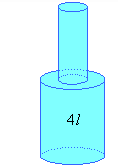
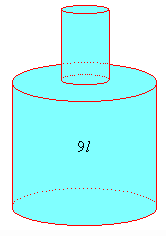
What you do have is a four litre and a nine litre container.

How do you measure out exact amounts using only these two containers?

Here is a start: Measuring eight litres

Fill the four litre and tip it into the 9 litre.  Do this again.  You now have eight litres in the nine litre container.

That's eight done. Can you work out how to measure all the others?